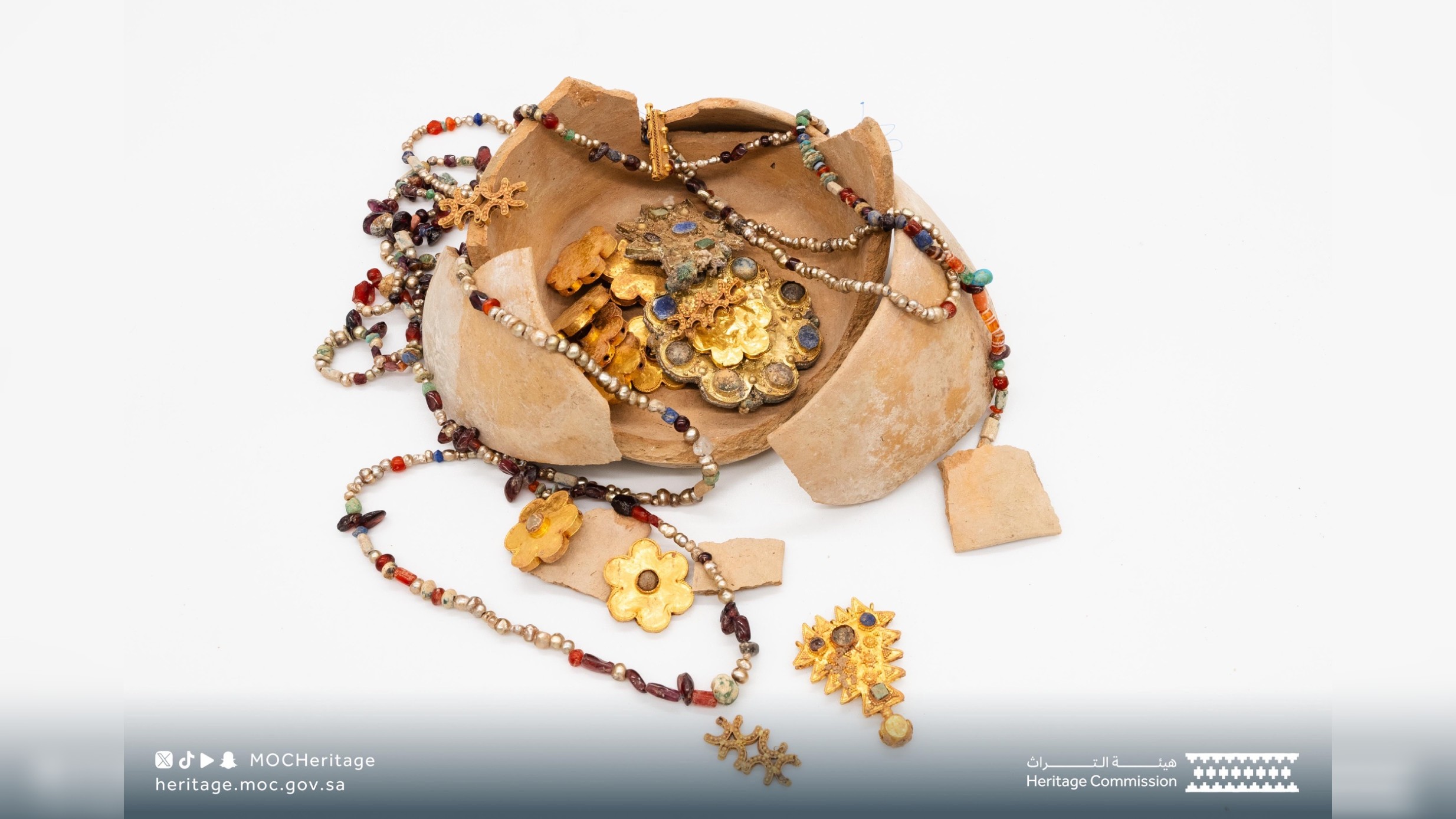
Riyadh. Dirt. Gold.
It wasn’t supposed to be there. At least not in this context. Archaeologists working just outside the modern metropolis of Riyadh struck something ancient and heavy. A clay pot. Inside sat more than 100 pieces of gold, silver, and jewelry studded with gems. The dirt has been on it for roughly 1,200 years.
The team calls it the Diriyah Treasure.
Diriyah feels like a place known for one specific thing in popular memory—the rise of the Saudi state, the original home of the House of Saud back in the 1700s. That is its postcard identity. But the ground there remembers older stories. Much older.
This particular find dates back to the very beginning of the Abbasid caliphate. We are talking about the window between 743 and 753 AD. Radiocarbon dating of organic waste at the site nailed it down to those exact decades. This was the dawn of an era often called the Islamic Golden Age. Baghdad was rising as a capital of the world, science was flourishing, art was blooming.
Diriyah sat on the edge of that world. Specifically, on a highway for faith.
The Hajj route. Pilgrims walked from Basra, a busy port in what is now southern Iraq, all the way west to Mecca. It was a dangerous trip. Long. Hot. You had to bury your wealth if you thought you might be robbed or if you simply wanted to carry less weight on the second half of the journey. Or perhaps you died. Did someone lose a step along the way? Or just stash a pot to pick up later? We don’t know.
“One of the most important discoveries of this Sixth Season was the uncovering of the Diriyah Treasure, which consists of a collection of Gold Pieces, gemstones, and oxidized Copper fragments.”
The quote comes from a lab expert at the Saudi Heritage Commission. They’ve been digging there for six years. Usually they find water basins. Gypsum walls. Pottery shards. Glass bits. Standard ancient refuse. This? This was a surprise.
The jewelry itself shows serious craft. Not mass-produced junk. Sheets of gold beaten flat, embossed, then inlaid with semi-precious stones. Floral patterns. Geometric designs. You could feel the hours a skilled artisan spent over a workbench.
Experts are guessing it belongs to a pilgrim. It fits the location perfectly. But they can’t say for sure who owned it. A merchant? A noble? A local resident who feared Mongol armies coming from the east? The Abbasid Empire held it together until 1258 when the Mongols crushed it, but in 753, things felt stable. Or at least stable enough to bury a pot of gold and expect to live another day.
More digging is planned. Of course. There’s always more digging.
But right now we have this image: a hand covering the mouth of a jar in the heat of a pre-modern summer. A hope for the future that never came back to claim its treasure.