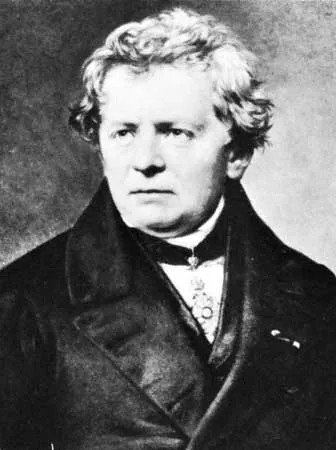
Georg Ohm changed how the world understands electricity. He was born on March 16, 1789, in Erlangen, Bavaria. His life ended in Munich on July 6, 1854. But the law that bears his name remains one of the most fundamental rules in physics.
Ohm discovered that current flow through a conductor is directly proportional to the potential difference, or voltage. It is inversely proportional to the resistance. This simple relationship defines how electricity moves. Without this understanding, modern electronics would not exist.
The Early Struggles of a German Physicist
In 1817, Ohm became a professor of mathematics at the Jesuits’ College in Cologne. He was a respected academic. His work was rigorous. But his approach to physics was different. He focused heavily on mathematical abstraction.
His most important contribution appeared in an 1827 pamphlet titled Die galvanische Kette, mathematisch bearbeitet. In English, this translates to The Galvanic Circuit Investigated Mathematically. The book detailed his findings on electrical circuits. It explained the relationship between voltage, current, and resistance.
The scientific community did not appreciate the work. They found it too theoretical. Too cold. The reception was harsh. Ohm was dismissed by peers who preferred experimental data over mathematical proof. The rejection was so severe that he resigned from his post in Cologne.
“While his work greatly influenced the theory and applications of current electricity, it was so coldly received that Ohm resigned his post at Cologne.”
Recognition After Decades of Silence
Ohm needed a new position. He accepted a job at the Polytechnic School of Nürnberg in 1833. He continued his research. He stayed true to his methods. But the world was not ready for his ideas.
It took over a decade for the scientific establishment to catch up. By the 1840s, engineers and physicists began to see the utility of his law. They realized that Ohm’s mathematical model predicted real-world behavior with precision.
In 1841, the Royal Society of London awarded him the Copley Medal. This was a significant honor. It signaled that his work was finally validated. A year later, in 1842, he was made a foreign member of the Royal Society.
The international community could no longer ignore him. The physical unit measuring electrical resistance, the ohm, was named in his honor. It serves as a permanent reminder of his contribution.
Why Ohm’s Law Still Matters Today
You might wonder why a 19th-century German physicist matters to you now. Think about every device you use. Your phone. Your computer. The lights in your home. All of them rely on the principles Ohm described.
Ohm’s law allows engineers to design circuits that work safely and efficiently. It prevents components from overheating. It ensures that devices receive the correct amount of power. Without this foundational knowledge, the electrical grid would be a chaos of short circuits and failures.
The journey from rejection to recognition was long. Ohm died in Munich in 1854. He never saw the full extent of his impact. But his law remains central to electrical engineering. It is one of the