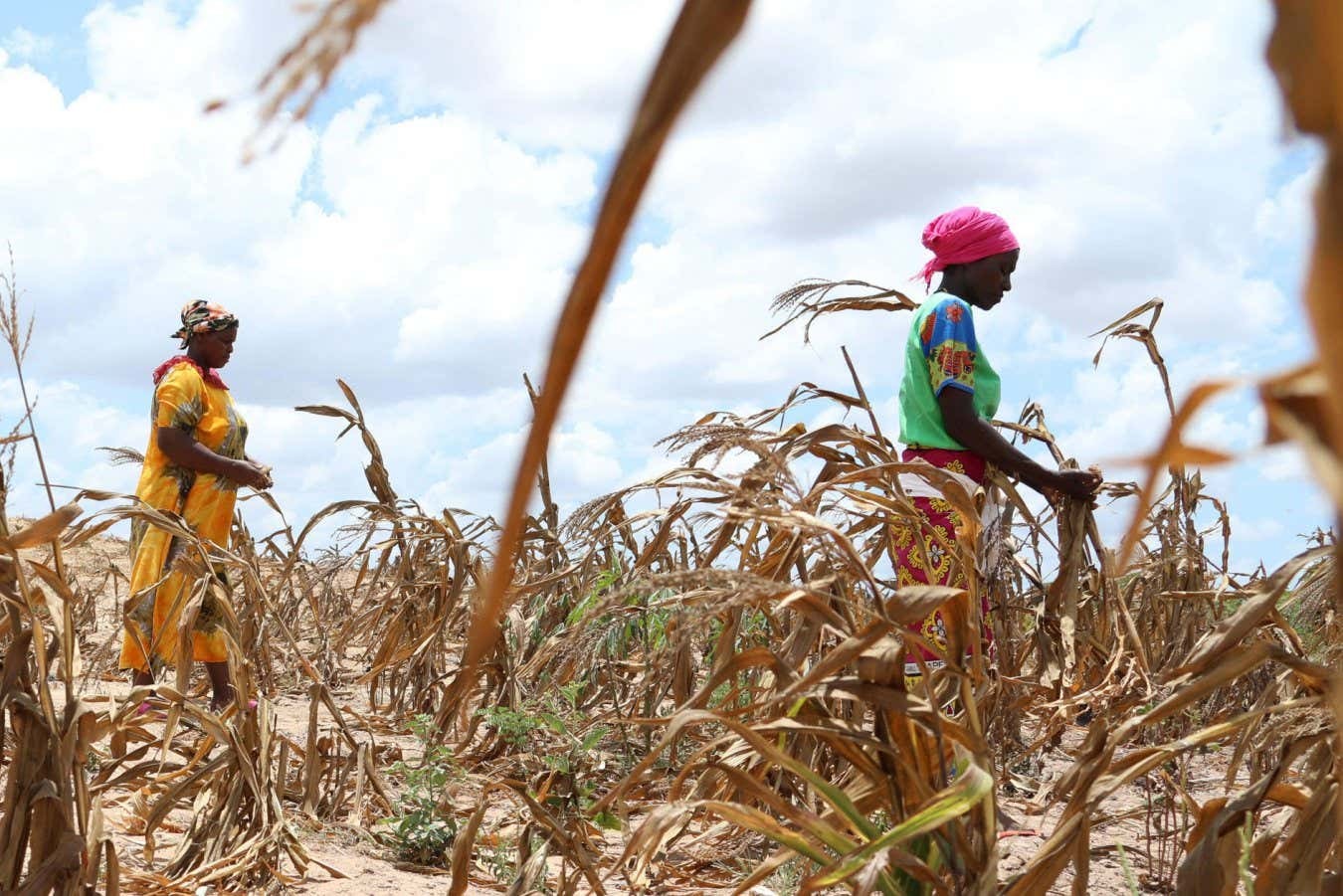
Heat is expensive.
A new study estimates that global warming has already shaved more than $20 billion a year off the yields of maize, wheat, and soybeans. That’s not a projection. That’s the current bill.
If we don’t slash emissions, that figure could multiply by eight by 2100—climbing past $160 billion in annual losses.
The uneven toll
Money matters. Geography matters more.
The financial hits will sting the biggest producers like the US, but the human cost falls heaviest on the lowest-income nations. In those places, most people farm. Most people live off the land. When the soil fails, societies crack.
“If you look at the least developed countries in Africa, the impact is much larger.”
Yi Ling Hwong of the International Institute for Applied Systems Analysis warns this isn’t just about bad harvests. It’s about migration. Unrest. The slow erosion of stability.
The mission to be wrong
Uncertainty is built into the math. Farmers adapt. They switch crops. They install irrigation. The study accounts for some of this, but it’s impossible to predict every pivot a farmer makes.
That’s actually the goal.
Kai Kornhuber, another team member at IIASA, frames the entire exercise as a wake-up call. Make these numbers so stark that people react. If we succeed in changing our behavior, the projections will look wrong. We want to be proven inaccurate.
The method
The team pulled yield data from the UN’s Food and Agriculture Organization. Then they mapped it against climate history.
From 1974 to 1974, they calculated drought levels using standard soil moisture models. They compared heat extremes to crop outputs. Then they ran the correlation forward from 2007.
The result? A 3.5% drop in yields relative to that baseline.
Three percent sounds small. It’s not. On a global food market, that variance triggers regional crises.
They valued those losses at the time of production. Then they projected forward.
The end game
Take the SSP3-7 scenario. A high-emissions path. By 2100, global yields for these three staples could plummet by roughly 35%.
Annual economic losses? More than $161 billion.
In physical terms, Hwong notes this equates to nearly 855 million tonnes of lost production. Roughly what 2 billion people eat in a year.
Missing the picture
This might be an underestimate.
Why? The study only tracks three crops. It ignores floods. It skips storms. It doesn’t factor in the price spikes that often follow shortages—as seen already with coffee and cacao.
There’s also debate over the method.
Jonas Jägermeyr of Columbia University argues the study overestimates the 2100 damage. Statistical models are good at explaining the past. They struggle when the climate shifts into entirely new regimes. Plant physiology models—which account for higher CO2—might be more reliable for the long game.
Karine Chenu at the University Of Queensland agrees on the method flaw but points out a twist: recent testing showed two major wheat models also make large errors when facing combined heat and drought.
So what’s better? Statistics or complex models?
Kornhuber defends the choice. Models can be unresponsive to extremes. This team wanted to look at extremes. They used statistics to capture those spikes directly.
It’s a messy picture.
The data is clear enough to worry about. The tools to predict it are still being fought over. And the bill is already due.
Emergency briefing: Nature as infrastructure
Don’t look for comfort.
Nathalie Seddon frames nature not as scenery, but as infrastructure. Break it, you get floods, heat deaths, and instability. Restore it, and you build economic resilience.
Kevin Anderson warns that 2°C by 2050 is likely. 4°C by 21210 is real. Under that curve, global economies don’t just shrink—they break down.
Paul Behrens puts it bluntly. The climate that gave us predictable harvests is dead. Food failure is now a national security risk. The UK isn’t ready.
The experts hosted by Rowan Hooper lay it out: time remains to avoid the worst. Just not much of it. 🌍